Showing posts with label Deep Sea. Show all posts

Monday, 14 July 2014

Chikyu cruise day 1

Today I boarded on the Research vessel Chikyu for a drilling cruise to my hydrothermal vent site. It is quite rare for biologists to board on this drilling ship because its purpose is mainly… drilling! And this activity interests mainly geologists. But in this cruise, before the drilling we will make a biological survey and now I discovered this very fancy ship and I will try to share my experience in the next posts.
So let’s start by the beginning: what is the Chikyu? Simply it is a gigantic ship (over 200 m long) made for drilling deep into the seafloor.


Because the ship is so big, it could not enter in the port in Nago, so we had to use a small tugboat to reach it.

From far it does not look so big...

But getting closer then we realise it is a BIG ship...


To give an idea of the size, the arrow points at one person standing on the helipad

In the coming days, I will try to find a few minutes to show you the inside of this unique ship and our research progress...

Wednesday, 30 October 2013

News from the Cruise Day 8


Our prayers were heard and we could have a full dive for our last chance to dive during this cruise. The dive started pretty well with several very interesting biological samples, as we were progressing through the dive, we could see more and more signs of hydrothermal activity, but we could still not find the exact venting sites (where the hot water full of sulphur and other minerals comes out of the seafloor). And the main objective of the dive where to find this exact point. As we were progressing towards the top of the volcano, not knowing how shallow Shinkai submersible could go, things started to get more complicated. Indeed, we were getting closer to the vents, but at the same time the Shinkai was caught in the plume of white water, charged with mineral particles, emitted by the vent and it was impossible to see anything further than 3-4 cm. At least we know we were getting closer. Finally with less than one hour remaining (and this is very short for a submersible dive) the Shinkai could get out of the plume and by chance find one of the vents. It was really exciting to see for the first time the hot hydrothermal fluid coming out of the Earth and sulphur "dripping" out of the stone. And what is really exciting for us biologists, is that in this extremely unfriendly environment there is a lot of life going on, with some fishes, crabs and mussels around the place. Probably if we would be swimming around, beside being burned by the hot water and intoxicated by so many poisonous chemicals, we would also get badly burned by the extreme acidity of the water. So it is amazing that so many animals could evolve ways to transform such toxic environments into a source of energy far from the light of the sun.

On a more technical perspective, this dive was was also the record of the shallowest dive of the Shinkai submersible. The Shinkai is made to dive at over 6000 meter depth, so taking it at less than 400 m depth was a challenge, especially with the strong current there was on the site.

Now we are on our way back to Auckland were we will have some outreach activity. And this is our new challenge, summarising all the exciting information we could obtain and transform the frustration of the cancelled dives into motivation to come here again and finish exploring these interesting places.
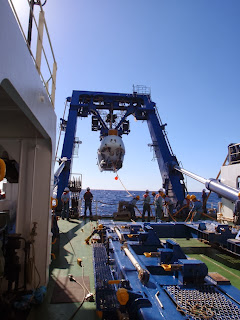

Shinkai goes in the water for the last time in this cruise

Happy scientists excited to see all the different samples collected
One of the most important thing for a successful cruise is the kitchen. If the food is good, everyhting is easier and the mood is higher. The only issue is that with the little exercise we make, the weight also gets "higher"...

Sunday, 27 October 2013

News from the Cruise Day 5

This post comes a bit late as the internet connexion was down yesterday...


Different conditions compared to yesterday


As we feared the weather is getting worse. We still launched the dive today but it had to be aborted early because sea conditions got too bad and it can be quite problematic to recover the Shinkai submersible in rough seas. Fortunately a few samples could still be collected and and the rocks sampled suggest that there is indeed hydrothermal activity. Maybe the hydrothermal vents were just a few meters away, it is quite frustrating to have to stop the dive half way through, but well if deep-sea research would be easy, maybe it would not be as exciting…

Tomorrow, it is very unlikely that we can dive with the submersible because of the sea conditions, but because our time is limited, we will still try to get images from one of our target seamount by towing a camera near the bottom of the sea behind the ship. We will not be able to get samples, but at least we can see what is living on the seamount.

Now it is time to take again some seasickness pills and wait for better weather...
Still we could catch one squat lobster
Some fish got accidentally trapped in the submersible, bonus samples
Beautful rocks for the geologists on board
A better picture of the squat lobster

Saturday, 26 October 2013

News from the Cruise Day 4

Today the sea was very calm and we could make the first dive of the cruise. The target was a very old (over 40 millions years old) underwater volcano (since long time extinct) named Canopus seamount. Malcom, our colleague form NIWA had the privilege to be the scientist on board of the submersible. It was his first dive and it is good that he is a really experimented scientist, because there was a lot of pressure on his shoulder to make everybody onboard happy. But he managed very well and now everybody is busy, and likely will be busy until late at night.
It was the first time we could get images from this volcano. We were surprised how rare are the animals, but still we could see several corals, sponges, shrimps and fishes. even an octopus came swimming in front of the shinkai to see what was this big thing full of lights disturbing the quiet environment of the deep-sea. I was happy because we found the animals on which the zoanthids I am interested are living, but unfortunately there were no zoanthids. Maybe we will find some in some of the next dives… However, I still have full hands with several sediments cores that have been collected.
Tomorrow we will leave deep seamount and cross the Kermadec Trench to go explore some active volcanic area to try to find some hydrothermal vents. This will be exciting because nobody saw those vents, we only know they are here because scientists found some specific chemicals in the water in the area a few years ago. I don't know what we will find, but whatever we will see it will be exciting to see for the first time what is going on down there. After that, the day after tomorrow, the weather looks not so good and we are worried if we can dive again (normally we planned to do 5 dives during this cruise).
All the equipment is ready, cores for sediments, some king of vacuum cleaner, boxes for samples and many equipment for the geologists.

The sea was perfect and the swimmers are ready to release the submersible.

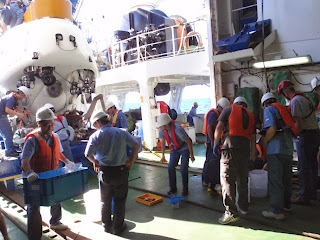
After the dive, everybody is busy to get the samples before they get too warm.

Some corals we collected around 2000 m deep

and my sediments!

Thursday, 24 October 2013

News from the Cruise Day 3

Today we arrived on the first site in the afternoon. The day was spent preparing the dive of tomorrow, the sea was calmed down and the weather is great, providing us with a beautiful sunset to close the day.
Everybody is looking forward for tomorrow and we hope that Malcom, our colleague from New Zealand who will dive, will find great samples for everybody.
The weather does not look ideal in the next days, so the samples from tomorrow may be very precious.
You can find a more official blog on this cruise here (bottom of the page, in Japanese): http://www.jamstec.go.jp/quelle2013/report/
Last check before diving tomorrow.

Beautiful sunset in the South Pacific, far away from any land.

News from the cruise day 2

Today we departed Tonga. As soon as we passed the reef I was happy to have taken seasickness pills. The sea is not bad, but not good either and ship is rolling quite a bit. We now have two days of navigation before reaching our first target at Louisville seamounts chain, but there is already a lot of activity going on on the ship. With 14 scientists on board and only 5 dives maximum with the submersible (if the weather is good) there is a lot of negotiations going on to make everybody happy. Then we also need to prepare the baskets in front of the submersible with all the equipments we will use.
This afternoon, we had a ceremony to pray for Konpira san, the god of the sea, the Japanese Poseidon, and we drunk some sake for him. Hopefully, he will be happy with our prayers and provide us with nice sea conditions for the cruise.

The ship last night in Nukualofa

It seems some captain tried a new shortcut to the beach...

Wednesday, 23 October 2013

News from the Cruise 1

First day in Tonga, weather was not so sunny but at least no rain. I got a bit worried for my seasickness next week when wind became stronger. But fortunately, conditions calmed down for the evening and I hope sea will be quiet.
Before enjoying a bit of souvenir shopping I could not resist to jump in the water a bit. Corals were very diverse and nice although the site was quite murky, and there was more fishes than in Okinawa (probably much less fishing pressure...)